
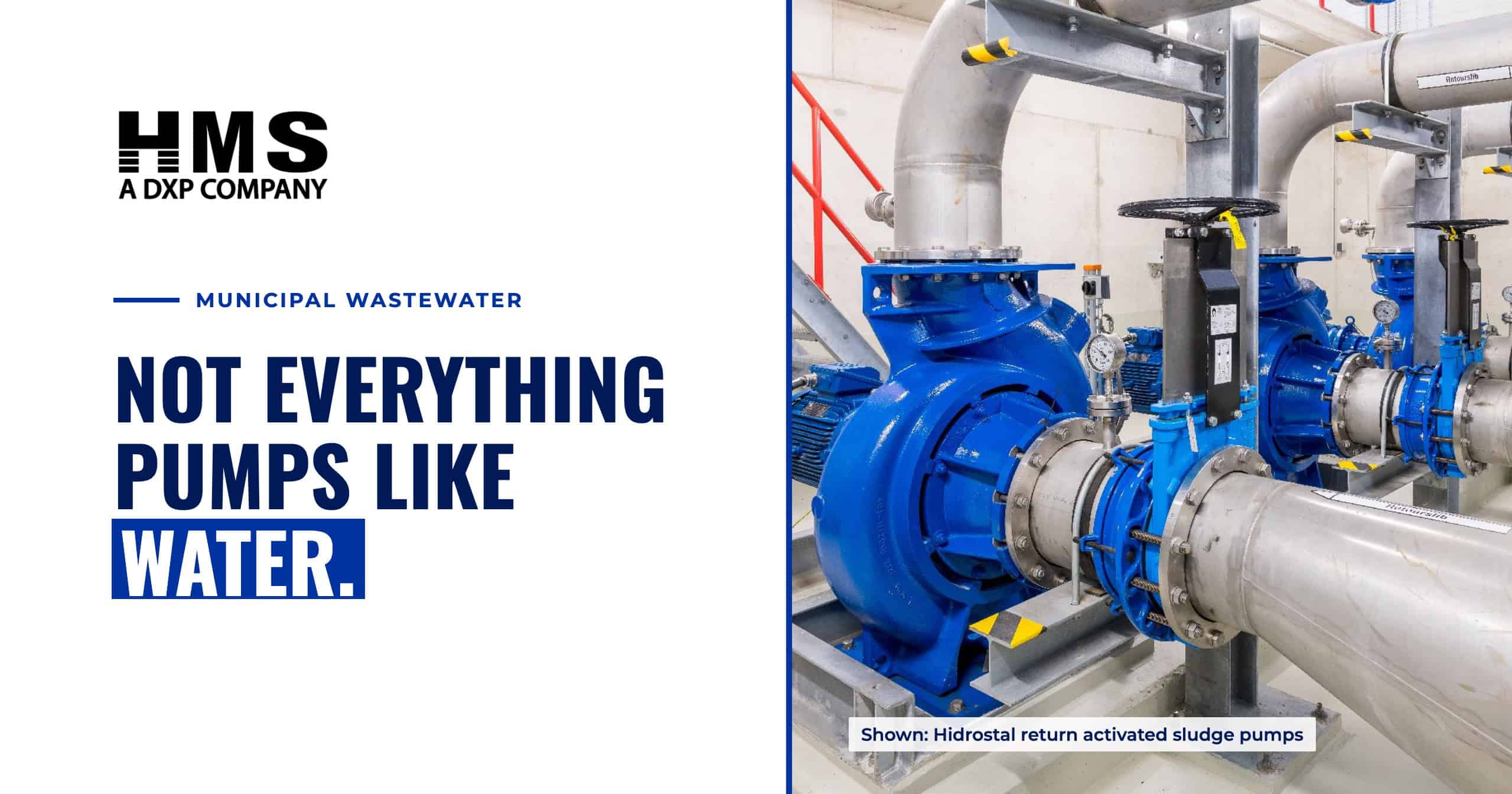
Most pump curves are published for clean water, and most of the water a utility moves behaves close to it. Wells, booster stations and distribution systems rarely force anyone to think about viscosity. Inside a wastewater treatment plant, though, the story changes. Thickened sludge, scum, grease and polymer solutions can be many times thicker than water, and a pump selected from a water curve may not deliver what the process needs.
Viscosity describes a fluid’s resistance to flow. As it rises, the energy required to move the fluid changes, sometimes dramatically. Understanding how the fluids in your plant behave helps operators and engineers choose equipment that runs reliably without wasting energy or wearing out early.
How Viscosity Changes Pump Performance
Thicker fluids create more resistance as they move through piping and pump passages. That raises friction losses across the system, so more pressure is needed to maintain the same flow.
Viscosity also affects efficiency. In centrifugal pumps, higher viscosity reduces flow and head while increasing the power the motor must deliver. The Hydraulic Institute publishes correction methods for exactly this reason: a pump that looks right on a water-based curve can fall short when it’s handling a heavier product.
In a treatment plant, the result shows up as sludge transfer that can’t keep pace, digesters that are fed unevenly, or motors that run hotter and draw more power than expected. Our earlier article on optimizing pump efficiency and reducing energy costs covers why those losses add up over a pump’s life.
Where Viscosity Matters in a Municipal Plant
Not every pump in a plant needs a viscosity review. The services that usually do include:
- Primary and thickened sludge — Sludge gets thicker as solids content rises, especially after thickening and before digestion or dewatering.
- Scum and FOG — Fats, oils and grease skimmed from clarifiers can be heavy and sticky, and they get worse in cooler weather. The EPA’s pretreatment program exists in part to keep FOG out of collection systems.
- Return and waste activated sludge — Usually manageable for centrifugal pumps, but solids content can vary with process changes.
- Polymer and chemical feed — Neat and aged polymer solutions can be very viscous, which affects metering accuracy.
- Digested sludge and biosolids — Handling and dewatering feed pumps must match the thickest material the process will produce. The EPA’s biosolids resources offer helpful background on how these materials are managed.
Centrifugal vs. Positive Displacement Pumps
Centrifugal pumps handle most low-viscosity services efficiently, including raw influent, effluent and much of the activated sludge loop. Screw-centrifugal designs, such as those from Hidrostal, extend that range by moving solids-laden and thicker sludges gently with a single-vane screw impeller. As viscosity climbs, however, centrifugal performance declines.
Positive displacement pumps often have the advantage with thicker fluids. Rather than relying on velocity, they move a defined volume with each cycle, so flow stays more consistent as viscosity changes. Progressive cavity, peristaltic (hose), rotary lobe and diaphragm pumps are commonly considered for thickened sludge, scum and polymer service.
Positive displacement pumps do need proper system protection. Because they keep building pressure against a closed valve or plugged line, pressure relief and controls are essential.
The right choice depends on the material, the solids content and the flow and pressure the process requires.
Temperature Can Change Everything
Viscosity isn’t constant. Grease, scum and many sludges thicken as they cool and thin as they warm. Arizona plants see this more than people expect: a line that runs smoothly on a summer afternoon may struggle on a cold January morning, or after a pump has sat idle long enough for its contents to cool.
Higher viscosity at startup raises power demand and makes suction harder. Evaluate the full range of operating conditions, not just a single sample. In some services, heat tracing, insulation or flushing routines may be needed to keep pumping conditions consistent.
Suction Conditions and Piping Design
Viscous fluids are harder to draw into a pump because friction losses in the suction line increase. Poor inlet conditions can cause incomplete filling, unstable operation or cavitation in susceptible designs. If you’ve struggled with suction problems before, our article on the role of NPSH in pump selection and system design explains the fundamentals.
Suction piping design matters even more with thick material. Larger piping, shorter suction runs, fewer fittings and flooded suction where possible all help deliver fluid to the pump.
Motor sizing deserves the same attention. Because viscosity raises power requirements, size motors and drives for the most demanding expected condition, not the average one.
Selecting for Long-Term Reliability
Viscosity affects more than the initial selection. Changes in solids content, temperature or treatment processes can shift performance throughout the equipment’s service life. When a plant upgrades thickening or changes polymer, the pumps downstream should be reviewed as well.
Accounting for these variables helps utilities avoid excessive energy use, recurring clogs and premature wear. It also supports better decisions about pump type, motor capacity and system configuration. If an existing sludge pump is already underperforming, our guide to diagnosing low flow at municipal pump stations is a good place to start.
Work With a Partner Who Knows Your Process
DXP Hennesy has served Arizona customers since 1986. Our team works with utilities and their engineers to evaluate fluid properties, solids content and operating conditions before recommending equipment, so every service gets a pump suited to what it actually handles.
If your plant handles sludge, scum or polymer, or an existing pump isn’t keeping up, contact DXP Hennesy at (602) 996-3444 or sales@hennesymech.com to discuss pump solutions built for your application.