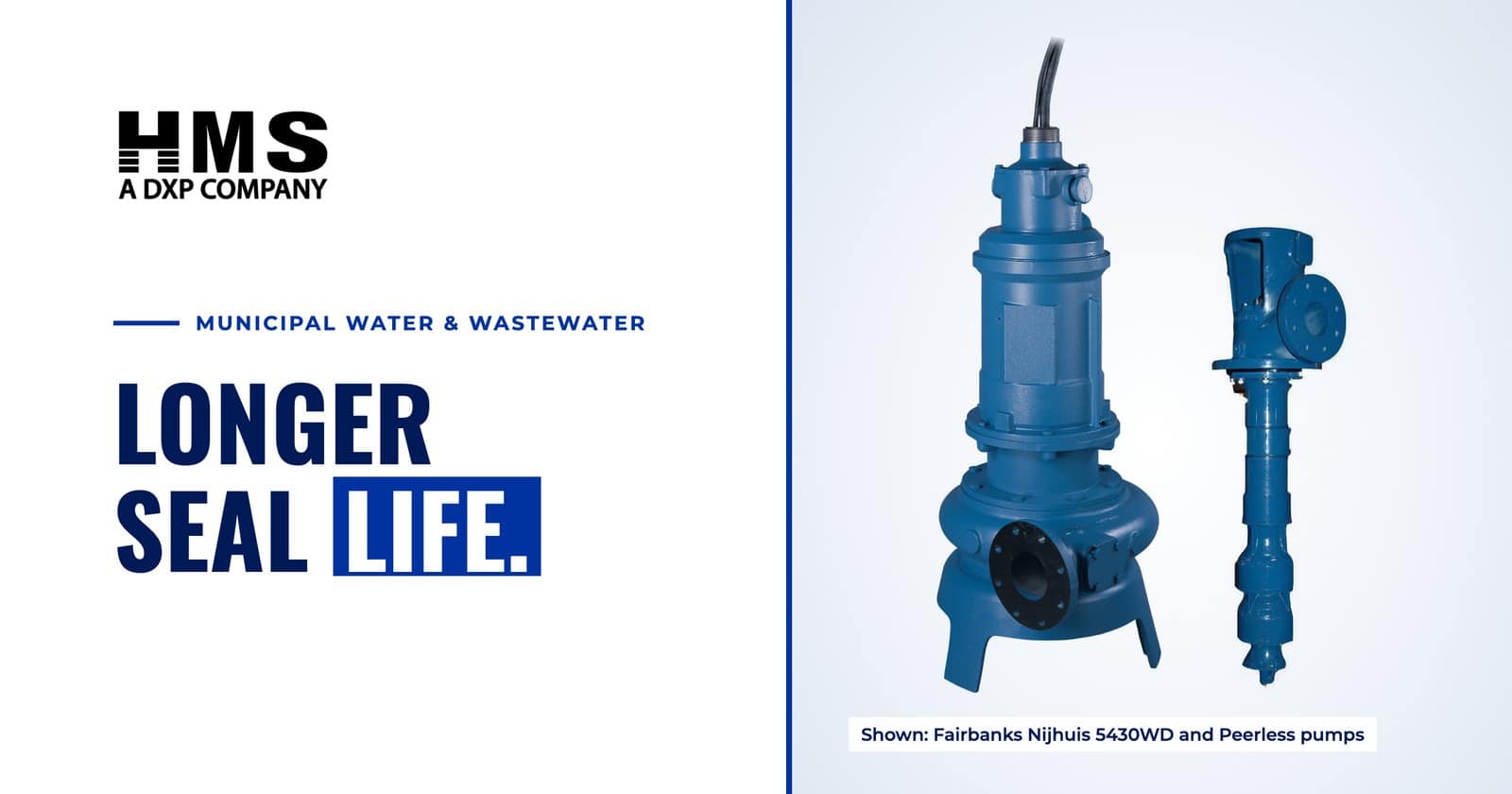
Mechanical seals keep water and wastewater from escaping along a pump’s rotating shaft. At a lift station, booster station or well, they are also one of the most common reasons a crew gets called out. A failed seal can mean a pump pulled from a wet well, a flooded seal chamber or a booster out of service during peak summer demand.
Seals are built for demanding service, but their life depends heavily on how the pump is installed, operated and maintained. Many of the conditions that shorten seal life can be corrected once operators know what to look for.
Keep Liquid at the Seal Faces
A mechanical seal relies on a thin film of liquid between its faces to control friction and carry away heat. When that film is lost, face temperatures rise quickly and damage can occur in minutes.
In municipal systems, dry running usually comes from a few familiar causes:
- Lift stations pumped down too far — A failed float, a drifting level transducer or an off setpoint can let pumps run after the wet well is drawn down.
- Well drawdown — Seasonal drawdown can lower the pumping level until a well pump draws air.
- Loss of suction at boosters — Low reservoir levels or upstream pressure loss can starve a booster pump.
- Startup without priming — Starting a horizontal pump before the casing and seal chamber are full of liquid.
Verifying level controls, low-level cutoffs and low-suction-pressure alarms protects the seals as much as the pumps. Where a seal flush or other seal support system is installed, it should be checked regularly to confirm it is delivering the required flow and pressure.
Control Vibration and Shaft Movement
Seal faces are designed to stay in close, steady contact. Vibration and shaft movement disturb that contact, break down the fluid film and accelerate wear.
Misalignment between pump and motor, worn bearings and pipe strain are common sources. So is operating far from the pump’s best efficiency point, which increases hydraulic loads on the shaft. Lift stations with ragging problems add another source: material wrapped on an impeller unbalances the rotating assembly.
Alignment checks after maintenance and routine vibration readings help catch these problems before they reach the seal. Our article on extending pump life with proper alignment and balancing covers the basics.
Match the Seal to the Water You Pump
What a pump handles has a direct effect on its seals. Sand drawn from a well is abrasive and can score seal faces. Grit and solids in wastewater can pack around seal components. Disinfection chemistry matters too, since some elastomers hold up better than others in chlorinated or chloraminated water.
When water quality changes, such as a new well source, a change in disinfection or a new industrial discharger on a sewer line, it is worth checking whether the existing seal faces and elastomers are still the right fit. Our article on how water quality impacts pump reliability goes deeper on these effects.
Reduce Stress at Startup and Shutdown
Every start and stop exposes a seal to changing pressure and temperature. A lift station pump that short-cycles because of a tight level band, or a booster that starts and stops with every swing in demand, puts more wear on its seals than one that runs steadily.
Reviewing level setpoints, pump alternation and VFD ramp settings can cut unnecessary starts. Startup procedures should confirm the pump and seal chamber are full of liquid and that any seal support system is running before the motor starts. Shutdown should follow the manufacturer’s recommendations, including any flush that needs to stay on.
Make Seal Checks Part of Routine Rounds
Seals usually give warning before they fail. Operators should watch for:
- Visible leakage or a change in leakage rate at the seal
- Seal-fail or moisture alarms on submersible pumps
- Higher temperature at the seal chamber or bearing housing
- New noise or vibration after maintenance
When a seal does fail, finding the cause matters as much as the replacement. Installing a new seal without correcting dry running, misalignment or a material mismatch often leads to the same failure a few months later. Our article on early warning signs of pump failure covers other symptoms worth tracking.
Longer Seal Life Starts With the Whole Station
Extending seal life takes attention to the complete pumping system: level controls, alignment, water quality and how the station runs day to day. Fewer seal failures mean fewer callouts, fewer pumps pulled and less pressure on maintenance budgets.
Work With a Partner Who Knows Your System
DXP Hennesy has served Arizona customers since 1986. Our team works with utilities and their engineers to evaluate operating conditions and find the root cause of repeat seal failures.
If your utility is seeing recurring seal failures at a lift station, booster or well, contact DXP Hennesy at (602) 996-3444 or sales@hennesymech.com.